Best Affiliate Marketing WordPress Themes 2026, Tested
The best WordPress themes for affiliate marketing: REHub, Mercury, Couponis and Tokoo compared by the kind of site each is built for.

Most lists of affiliate marketing themes are written from the themes’ sales pages. We did something different: we installed thirteen of them on the same WooCommerce test store, put the same affiliate review post on it, and measured how heavy that post was in each theme, what each theme does for affiliate links, and what it leaves behind if you switch away. Prices are the developers’ own, read on 6 October 2026, with renewals and the cost over three years.
How we tested. Every theme ran on the same store (WordPress 7.0.2, WooCommerce 11.1.2), one at a time, with only the plugins the theme itself marks as required. We measured four pages in Chrome, ran Lighthouse three times on the review post, and built one example of each affiliate theme’s own feature: REHub’s offer box, Mercury’s ranked list and Couponis’s coupon code. The full method is near the end.
The short answer
- For most affiliate blogs: GeneratePress. It loaded the lightest version of our review post (165.1 KB, 20 requests), scored 94 in Lighthouse, and GP Premium is $59 a year for up to 500 sites. Add a link plugin and you have everything a review site needs.
- For price comparison, deals and review boxes built in: REHub, at $59 once. Its review box printed Review and Product structured data on our REHub test post. The cost is lock-in: it registers 131 shortcodes, and the ones we used turned into raw text when we switched theme.
- For “top 10” ranked lists: Mercury. It has ranked lists with scores and buttons built in, but it is still gambling-first underneath (its default button reads “Play Now”), and our post weighed 454.6 KB in it.
- Cheapest over three years for one site: the free themes cost nothing. The one-time ThemeForest themes cost $39 to $69, the cheapest yearly plan is OceanWP’s Starter at $125.20 over three years, and Genesis Pro, which Authority Pro needs if you are not on WP Engine, is $1,080.
All thirteen at a glance
| Theme | Built for | Free version | Lowest paid price (one site) | Review post in our test |
|---|---|---|---|---|
| GeneratePress | Any site, lightweight | WordPress.org, 500,000+ installs | $59 a year (GP Premium) | 165.1 KB, 20 requests |
| Kadence | Any site, block-based | WordPress.org, 500,000+ installs | $99 a year (Essentials) | 206.9 KB, 25 requests |
| Neve | Any site, lightweight | WordPress.org, 200,000+ installs | $69 the first year, then $139 | 208.5 KB, 22 requests |
| Blocksy | Any site, block-based | WordPress.org, 300,000+ installs | $69 a year, or $199 once | 209.8 KB, 20 requests |
| Astra | Any site, page-builder friendly | WordPress.org, 1,000,000+ installs | $69 a year (Astra Pro on its own) | 218.9 KB, 20 requests |
| OceanWP | Any site, WooCommerce | WordPress.org, 400,000+ installs | $42 the first year (sale) | 489 KB, 44 requests |
| Divi | Visual page builder | Paid only | $89 a year, or $249 once | 283.1 KB, 34 requests |
| Authority Pro | Experts and coaches, Genesis child theme | Paid only | $360 a year (Genesis Pro), or free with WP Engine hosting | 340.3 KB, 34 requests |
| REHub | Price comparison, deals, reviews | Paid only | $59 once | 212.7 KB, 38 requests |
| Mercury | Reviews and ranked lists | Paid only | $69 once | 454.6 KB, 32 requests |
| Couponis | Coupon sites | Paid only | $39 once | 335.7 KB, 33 requests |
| Tokoo | Affiliate store that looks like a shop | Paid only | $59 once | 379 KB, 46 requests |
| Schema | Blogs, sold as an “SEO” theme | A free version on its developer’s site | $39 (sale; normally $49) | 477.3 KB, 34 requests |
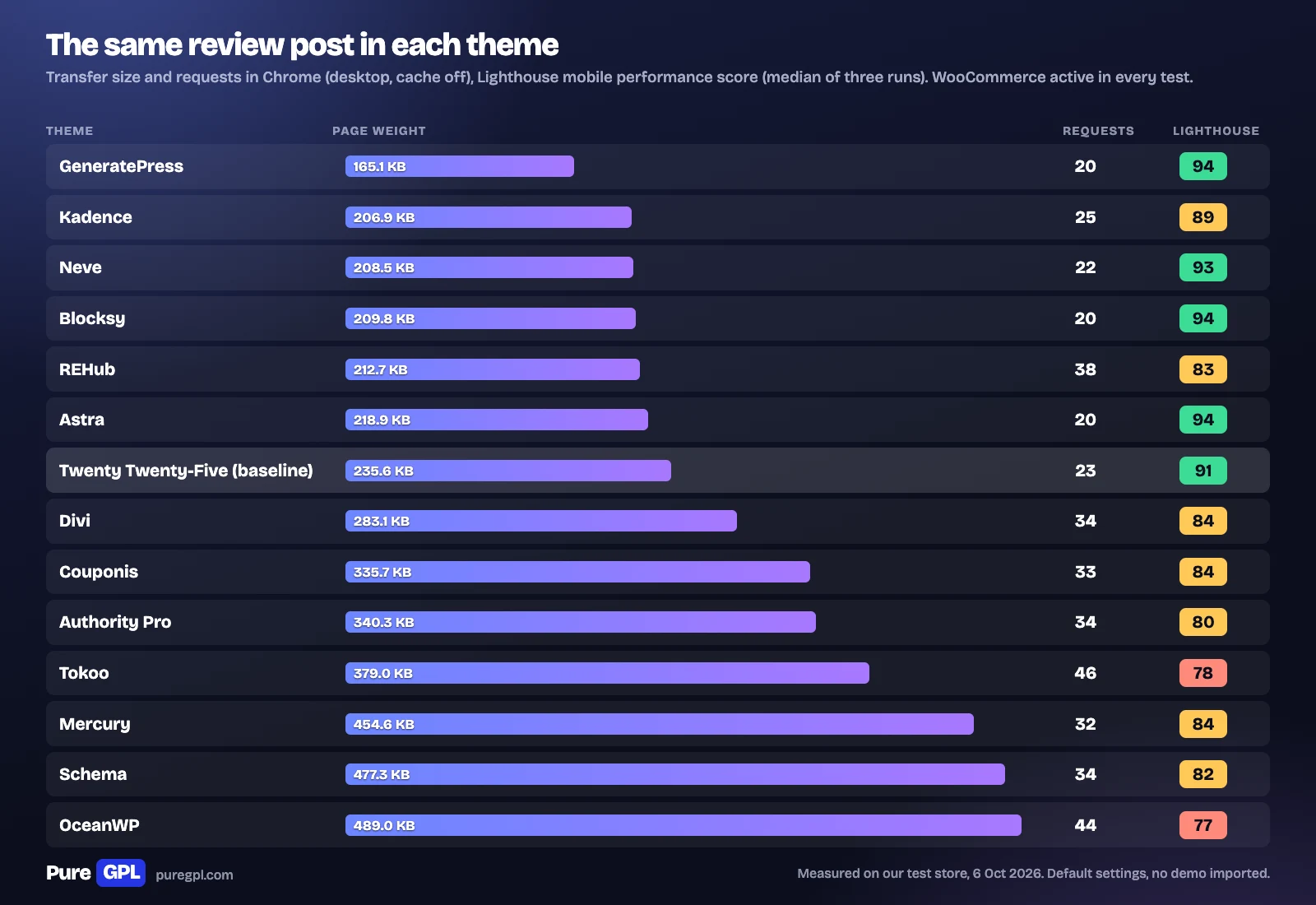
Twenty Twenty-Five, WordPress’s default theme, loaded the same post at 235.6 KB and 23 requests, so six themes came in lighter than WordPress’s own: GeneratePress, Kadence, Neve, Blocksy, REHub and Astra. Clipper, a coupon theme several lists include, is covered separately below: we could not test it.
The deciding question: do you need an affiliate theme at all?
An affiliate link works in any theme. What an “affiliate theme” adds is the furniture around the links: review boxes with scores, ranked lists with buttons, coupon codes that reveal on click, or price comparison tables. If your site is mainly articles, a light general theme does the job and leaves the furniture to blocks or a plugin such as Pretty Links or AAWP.
In our tests, each of the four affiliate-built themes made more requests on the same post (32 to 46) than any of the five lightest general themes (20 to 25), and three of them register their own content types or shortcodes that your posts come to depend on. That is a fair trade when the whole site is coupons, comparisons or ranked lists. It is a poor one for a blog with a few product boxes.
| Your site | Our pick | Why |
|---|---|---|
| Review blog with some product boxes | GeneratePress or Kadence | Lightest in our test; add a link or product-box plugin |
| Amazon or multi-network price comparison | REHub | Comparison, offer and review blocks, and Content Egg support in its code |
| “Top 10” ranked lists with scores | Mercury | Ranked lists with scores and buttons, with Review structured data on each item |
| Coupon site | Couponis | Click-to-reveal codes, store pages, visitor submissions; no developer support |
| Affiliate store that looks like a shop | Tokoo, or any WooCommerce theme | WooCommerce’s own external product type did the work in every theme we tested |
| You want to drag and drop every page | Divi | Visual builder, $249 once for unlimited sites |
Page weight and speed, measured
Every theme loaded the same four pages: the home page, our review post (a comparison table, three product sections with images and “Check price” buttons, and two FAQ blocks, all built with WordPress’s own blocks), the shop and one product. WooCommerce was active in every test, which is why even the lightest themes make around 20 requests.
| Theme | Review post | Home | Shop | Lighthouse (mobile) | Largest paint |
|---|---|---|---|---|---|
| GeneratePress | 165.1 KB, 20 requests | 229.6 KB | 217.9 KB | 94 | 2.8 s |
| Kadence | 206.9 KB, 25 requests | 235 KB | 242 KB | 89 | 3.4 s |
| Neve | 208.5 KB, 22 requests | 226.1 KB | 218.4 KB | 93 | 3 s |
| Blocksy | 209.8 KB, 20 requests | 226.3 KB | 320.6 KB | 94 | 2.9 s |
| REHub | 212.7 KB, 38 requests | 207 KB | 276.7 KB | 83 | 4.3 s |
| Astra | 218.9 KB, 20 requests | 302 KB | 216 KB | 94 | 2.8 s |
| Twenty Twenty-Five (baseline) | 235.6 KB, 23 requests | 232.2 KB | 432.4 KB | 91 | 3.3 s |
| Divi | 283.1 KB, 34 requests | 518.6 KB | 579.5 KB | 84 | 4.1 s |
| Couponis | 335.7 KB, 33 requests | 506.2 KB | 420.6 KB | 84 | 3.8 s |
| Authority Pro | 340.3 KB, 34 requests | 356.6 KB | 383.1 KB | 80 | 3.3 s |
| Tokoo | 379 KB, 46 requests | 301.4 KB | 383.2 KB | 78 | 4.8 s |
| Mercury | 454.6 KB, 32 requests | 430.9 KB | 533.8 KB | 84 | 3.7 s |
| Schema | 477.3 KB, 34 requests | 373.2 KB | 339 KB | 82 | 2.7 s |
| OceanWP | 489 KB, 44 requests | 552.3 KB | 526.5 KB | 77 | 5.1 s |
Where the weight comes from:
- OceanWP loaded 29 scripts on the review post and an icon font of 154.8 KB (Font Awesome), more than GeneratePress’s whole page of scripts and styles together.
- Mercury loaded 216.7 KB of fonts, 180 KB of it Font Awesome, plus Google Fonts from Google’s servers.
- Schema, which its developer calls “the fastest loading, ultra-SEO friendly WordPress theme”, had the quickest largest paint in our test (2.7 s), but it also loaded scripts from Facebook, Twitter and Pinterest on every post by default; with its Google Fonts, 212.3 KB of our post came from other companies’ servers. Its layout shift was 0.259 in the median Lighthouse run, above the 0.25 Google treats as poor, and its three Lighthouse scores were the least steady of any theme: 77, 82 and 95.
- Divi, Authority Pro, Couponis, Tokoo, Mercury and Schema load fonts from Google’s servers. If your readers are in the EU, that is a request to Google you may need to cover in your privacy notice, or switch off.
- GeneratePress, Kadence, Neve, Blocksy, Astra and OceanWP made no requests to other companies’ servers at all on our post.
Our store ran on a local computer, so the absolute Lighthouse scores and timings will differ on a real host. The order is what to look at: every theme was measured the same way on the same day. The weights are bytes transferred in our Chrome test; Lighthouse’s own simulated mobile load counts differently and found Schema heavier than OceanWP.
The first screen and the headings
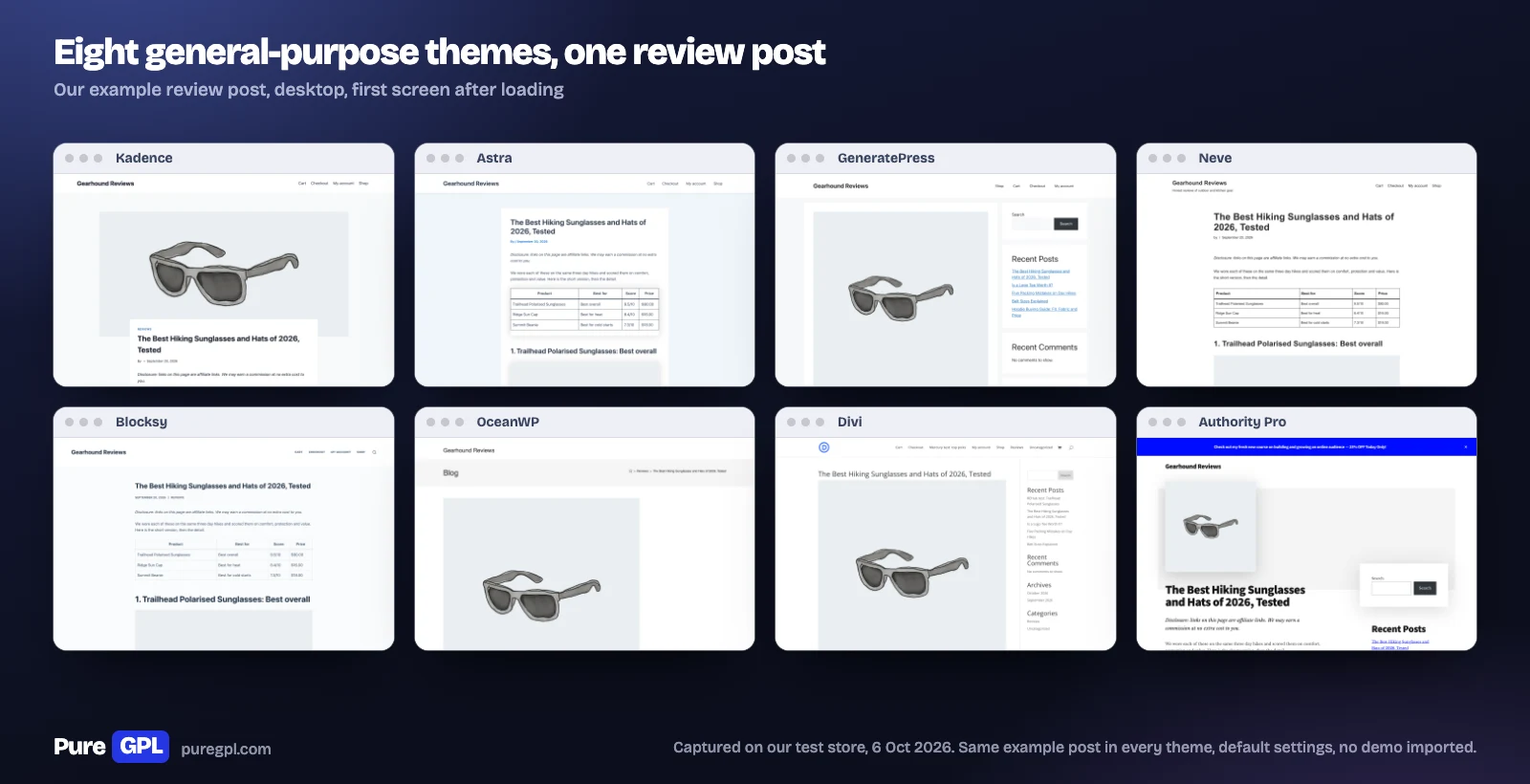
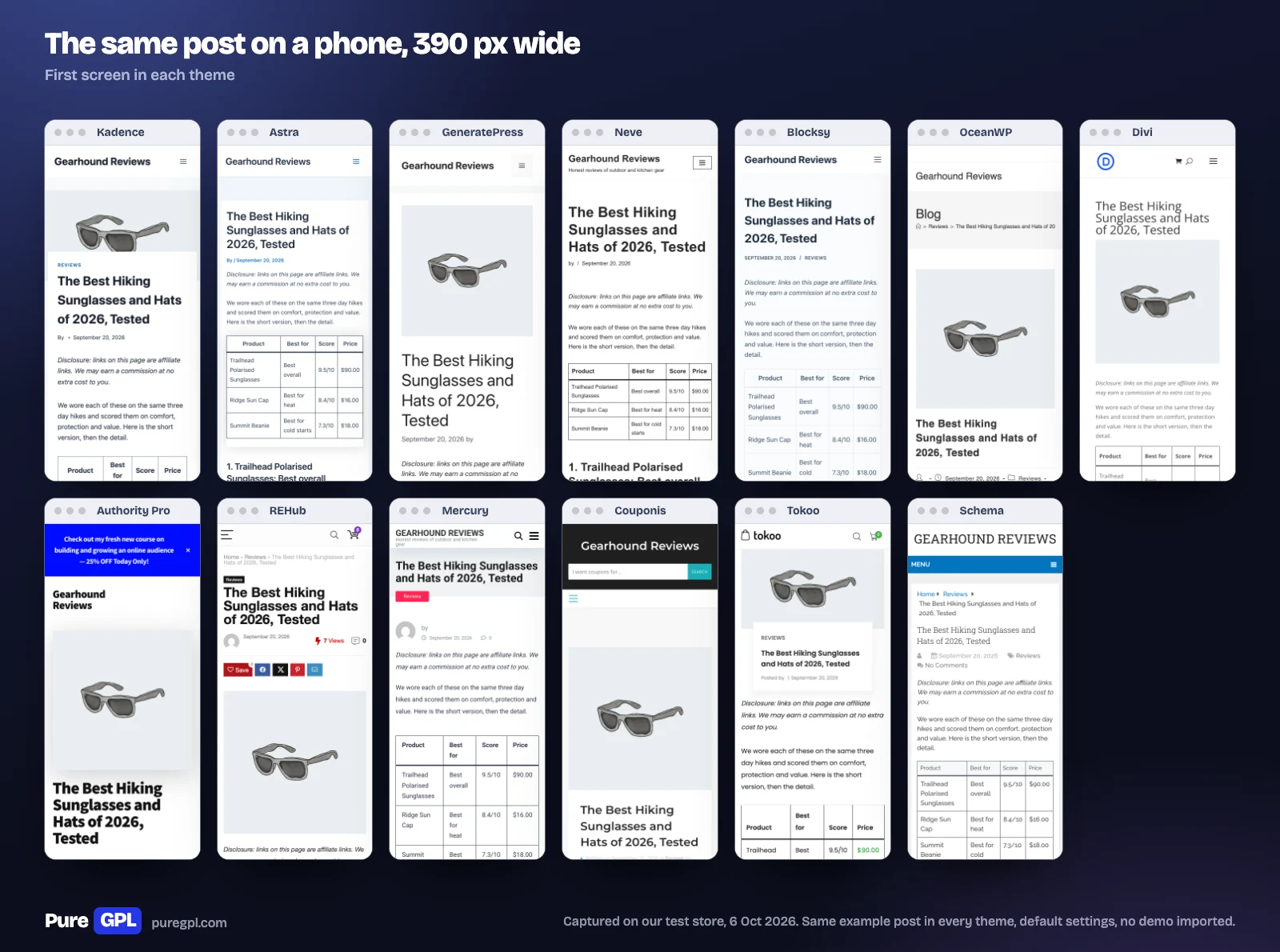
A reader who lands on a review should see what it is about. We checked where each theme put our post’s title on a 1440 by 900 desktop screen and a 390 by 844 phone screen, and which heading it used. Our featured image was a square, 801 pixels wide, so themes that put it above the title push the title down.
| Theme | Title on the first desktop screen | Title on the first phone screen | Featured image above the title | Post title is the page’s first-level heading |
|---|---|---|---|---|
| GeneratePress | Below the first screen | Yes | Yes | Yes |
| Kadence | Yes | Yes | Yes | Yes |
| Neve | Yes | Yes | Title first | Yes |
| Blocksy | Yes | Yes | Title first | Yes |
| REHub | Yes | Yes | Title first | Yes |
| Astra | Yes | Yes | Title first | Yes |
| Divi | Yes | Yes | Title first | Yes |
| Couponis | Below the first screen | Yes | Yes | Yes |
| Authority Pro | Yes | Yes | Yes | Yes |
| Tokoo | Yes | Yes | Yes | No first-level heading; title is a second-level heading |
| Mercury | Yes | Yes | Title first | Yes |
| Schema | Yes | Yes | Title first | Yes |
| OceanWP | Below the first screen | Yes | Yes | Only “Blog”; title is a second-level heading |
| Twenty Twenty-Five (baseline) | Yes | Yes | Title first | Yes |
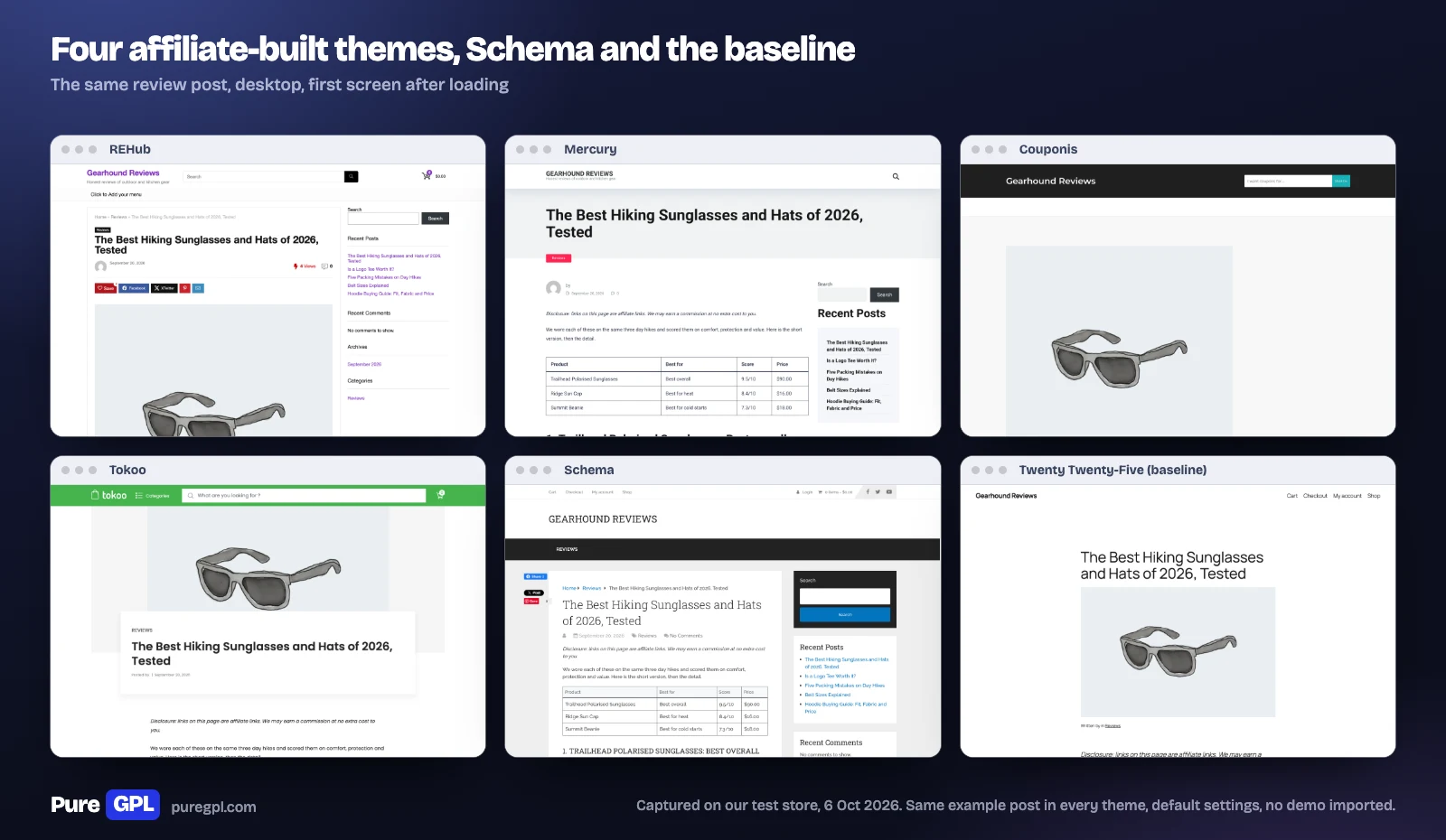
Six themes put the featured image above the title. In GeneratePress, Couponis and OceanWP that moved our title off the first desktop screen; in Kadence, Authority Pro and Tokoo the title still made it. Tokoo printed the title as a second-level heading and the page had no first-level heading at all. OceanWP used “Blog” as the page’s only first-level heading. Each of these is a default you can change.
Requests to other companies’ servers
Every request to another company’s server is a visitor’s IP address sent to that company, and in the EU it can need consent. This is what each theme fetched from elsewhere when our review post loaded, with default settings.
| Theme | Other servers contacted | Downloaded from them |
|---|---|---|
| GeneratePress | None | 0 KB |
| Kadence | None | 0 KB |
| Neve | None | 0 KB |
| Blocksy | None | 0 KB |
| Astra | None | 0 KB |
| OceanWP | None | 0 KB |
| REHub | Gravatar | 1.3 KB |
| Tokoo | Google Fonts | 31.8 KB |
| Mercury | Google Fonts, Gravatar | 40.7 KB |
| Couponis | Google Fonts | 60.4 KB |
| Divi | Google Fonts | 96.3 KB |
| Authority Pro | Google Fonts | 98.3 KB |
| Schema | Facebook, Google Fonts, Pinterest, Twitter | 212.3 KB |
Gravatar is the author’s avatar beside the byline. Schema’s Facebook, Twitter and Pinterest scripts come from its share buttons, which load on every post.
Price over three years
Most lists quote one price per theme. That hides two things: first-year sale prices that renew higher, and one-time ThemeForest prices that include only six months of support. These are the developers’ own figures, read on 6 October 2026.
| Theme (plan) | First year | Renewal | Three years, one site |
|---|---|---|---|
| Couponis | $39 once | None; no support from the developer | $39 |
| REHub | $59 once (6 months support) | None; support extension $17.63 | $59, or $76.63 with 12 months support |
| Tokoo | $59 once (6 months support) | None; support extension $17.63 | $59, or $76.63 with 12 months support |
| Mercury | $69 once (6 months support) | None; support extension $21.38 | $69, or $90.38 with 12 months support |
| OceanWP (Starter) | $42 (introductory; normally $52) | 20% off full price: $41.60 | $125.20 |
| GeneratePress (GP Premium) | $59 | Renews yearly; no separate renewal price given | $177 |
| Blocksy (Personal) | $69 | Not stated | $207 (or $199 once for lifetime) |
| Astra (Astra Pro on its own) | $69 | Not stated | $207 (or $249 once for lifetime) |
| Divi | $89 | Not stated | $267 (or $249 once for lifetime) |
| Kadence (Essentials) | $99 | Not stated | $297 |
| Neve (Personal) | $69 (normally $139) | $139, “all renewals are at full price” | $347 |
| Authority Pro (Genesis Pro) | $360 | Not stated | $1,080, or free on WP Engine or Flywheel hosting |
| Schema | $39 (sale; normally $49), 1 year of updates and support | Not stated | Not calculable |
Where a renewal price is not stated, the three-year figure assumes the price you pay today. A one-time ThemeForest licence keeps the updates: Envato’s support policy says “the new version of the item will automatically be made available to previous buyers through the Downloads page”. What expires after six months is the developer’s support.
For an agency or a portfolio of affiliate sites, the order changes completely:
| Theme (plan that covers ten sites) | Three years, ten sites | Per site |
|---|---|---|
| GeneratePress (GP Premium, up to 500 sites) | $177 | $17.70 |
| OceanWP (Business, 10 sites: $95, then $84) | $263 | $26.30 |
| Divi (unlimited sites) | $267, or $249 once for lifetime | $26.70, or $24.90 |
| Blocksy (Business, 10 sites) | $297 | $29.70 |
| Neve (Personal, unlimited sites) | $347 | $34.70 |
| Couponis (ten licences) | $390 | $39 |
| REHub or Tokoo (ten licences) | $590 | $59 |
| Mercury (ten licences) | $690 | $69 |
| Astra (Essential Toolkit, 10 sites: $199, then $299) | $797 | $79.70 |
| Authority Pro (Genesis Pro, unlimited sites) | $1,080 | $108 |
| Kadence (Essentials, priced per site) | $2,970 | $297 |
A ThemeForest Regular License covers “one unique end product”, so ten sites need ten licences. Kadence’s pricing page says “Plans are priced per site”.
The affiliate-built themes, and Schema
1. REHub
REHub, by Sizam, is the theme most affiliate site builders already know: 38,722 sales on ThemeForest, rated 4.89 from 1.7K reviews, last updated 28 June 2026. It is built for price comparison, deals and coupons, product reviews and multi-vendor shops, and it needs its own REHub Framework plugin, which comes in the download.
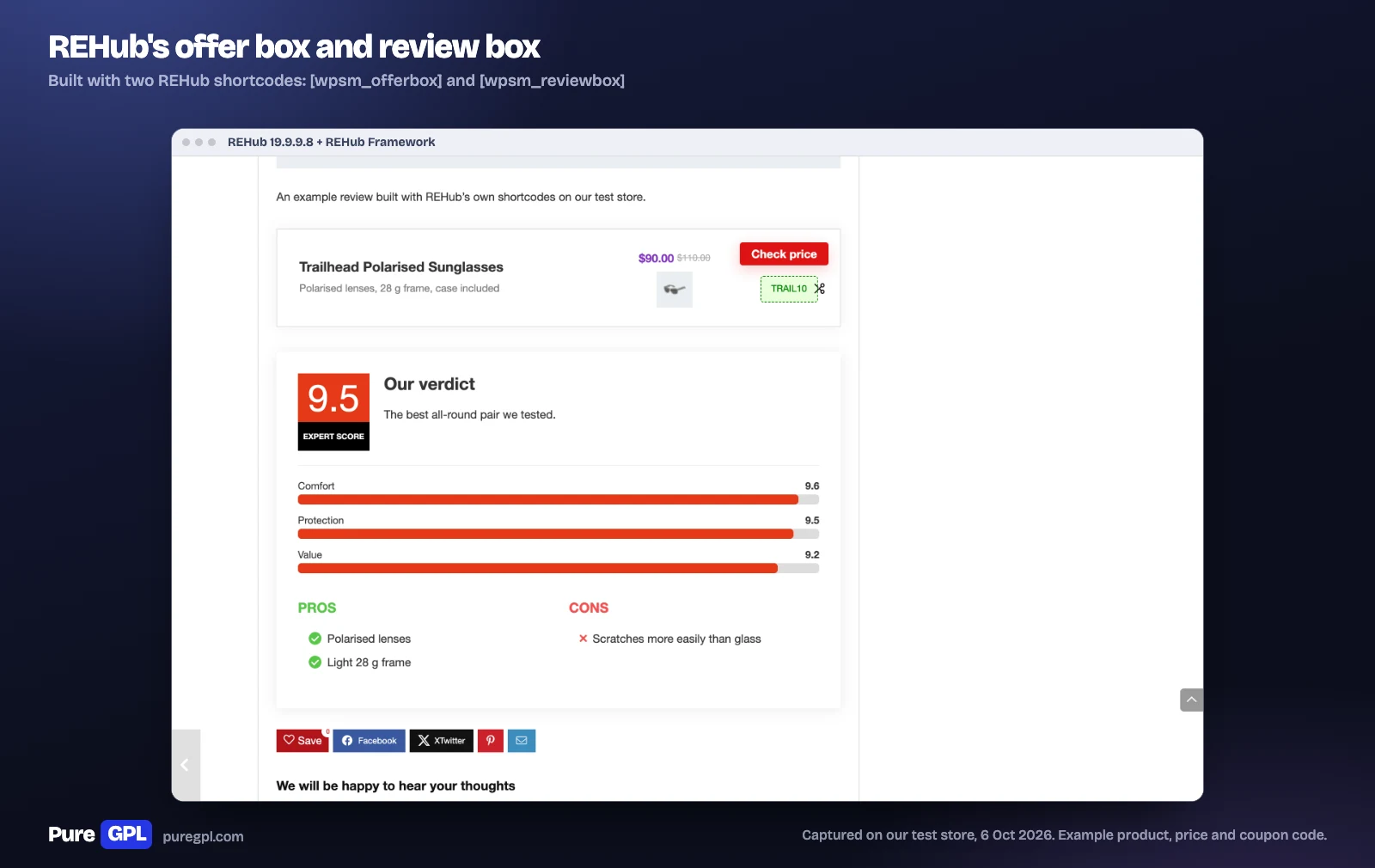
On our test store we built a review with two of its shortcodes. The offer box showed the product, its price against a struck-out old price, a “Check price” button and a coupon code; the review box showed a 9.5 expert score, a bar for each criterion, and pros and cons. With the score set, REHub printed Review, Product and AggregateRating structured data in the page, which none of the general themes did for our post. Its code also has templates for Content Egg, a plugin that pulls offers and prices from affiliate networks.
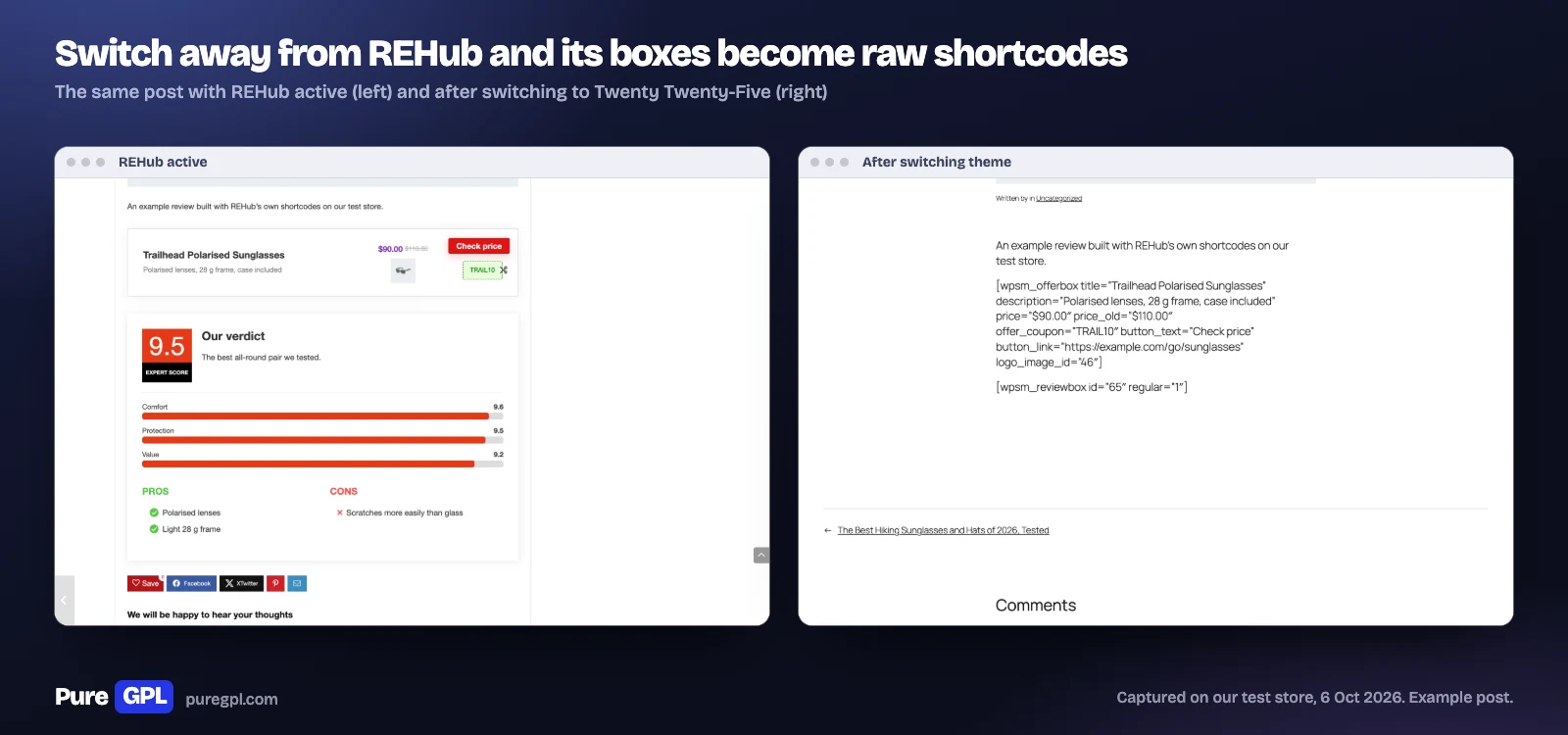
The catch is lock-in. With its framework active, REHub registered 131 shortcodes and 48 blocks. When we switched our store back to Twenty Twenty-Five, both boxes on our test post turned into raw shortcode text. Without a demo imported, REHub’s first screen was a plain blog layout with a sidebar, social buttons and a view counter on the post.
Best for: price comparison and deals sites that will stay on REHub. Skip it if: you want a light blog you can move off later. Our full REHub review covers its demos and setup in detail.
2. Mercury
Mercury, by Space-Themes, is now titled “Mercury – Affiliate WordPress Theme” on ThemeForest (6,156 sales, rated 4.79 from 201 reviews). It runs on the developer’s ACES plugin, which adds three content types: casinos, games and bonuses. Together, Mercury and its plugins registered 42 shortcodes on our store, for ranked lists, ratings, bonus codes and offer cards.
We renamed the Casinos section to “Products” in ACES’s settings, added three example items with scores, and built a ranked list with its [aces-casinos-4] shortcode. It produced numbered rows with a score and two buttons each. Each item’s own page printed Review structured data.
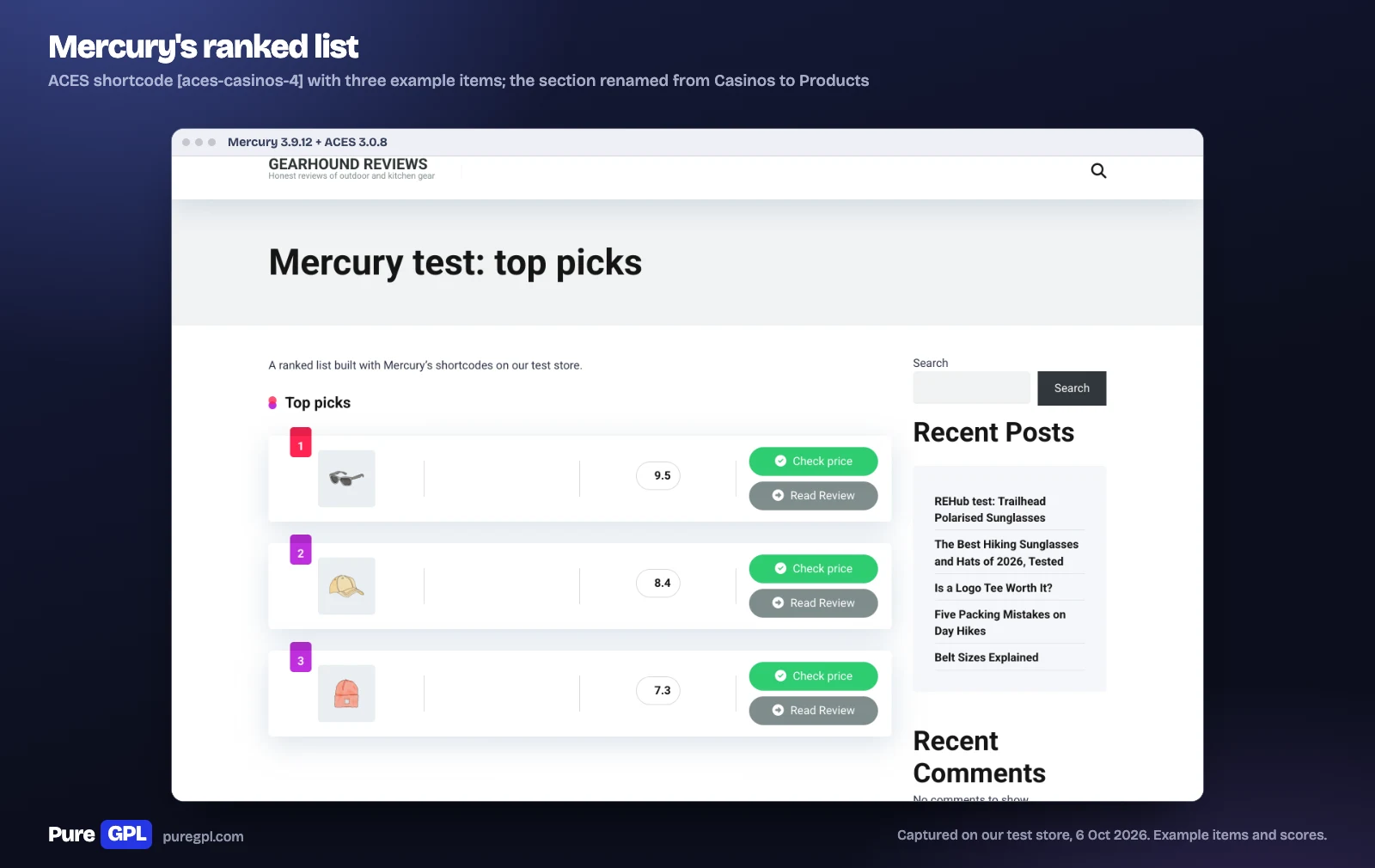
Three things we did not expect. First, the list’s main button goes to the item’s own review page unless you add external_link="1" to the shortcode. Second, if you leave an item’s button label empty, ACES falls back to “Play Now”. Third, renaming the section did not change the address: our items still lived at /casino/. Mercury works for hosting, software or VPN review sites, but it was built for gambling and it shows in the details.
We tested version 3.9.12. The developer’s current version is 3.11, released 6 April 2026, which its changelog says is compatible with WordPress 7.0.
Best for: “best X” sites built from ranked lists. Skip it if: page weight matters most: our post weighed 454.6 KB in Mercury, against 165.1 KB in GeneratePress. See our Mercury review.
3. Couponis
Couponis, by spoonthemes, is a coupon theme: store pages, coupon categories, visitors submitting coupons, and the “click to reveal” button that coupon sites use to record the affiliate click. It costs $39 on ThemeForest (2,000 sales, rated 4.87 from 97 reviews), and needs Redux, Elementor and two plugins from its own download.
The important line is on its ThemeForest page: “spoonthemes does not support this item”. The item was last updated on 9 June 2026, but you are buying it without the developer’s help.
We added a store and a coupon with the code TRAIL10. Before the click, the page showed only the code’s last four characters; GET CODE opened a window with the full code, a “Did it work?” vote and share buttons. Coupons are Couponis’s own content type, and their expiry dates, types and votes are kept in a database table of its own, which another theme will not read.
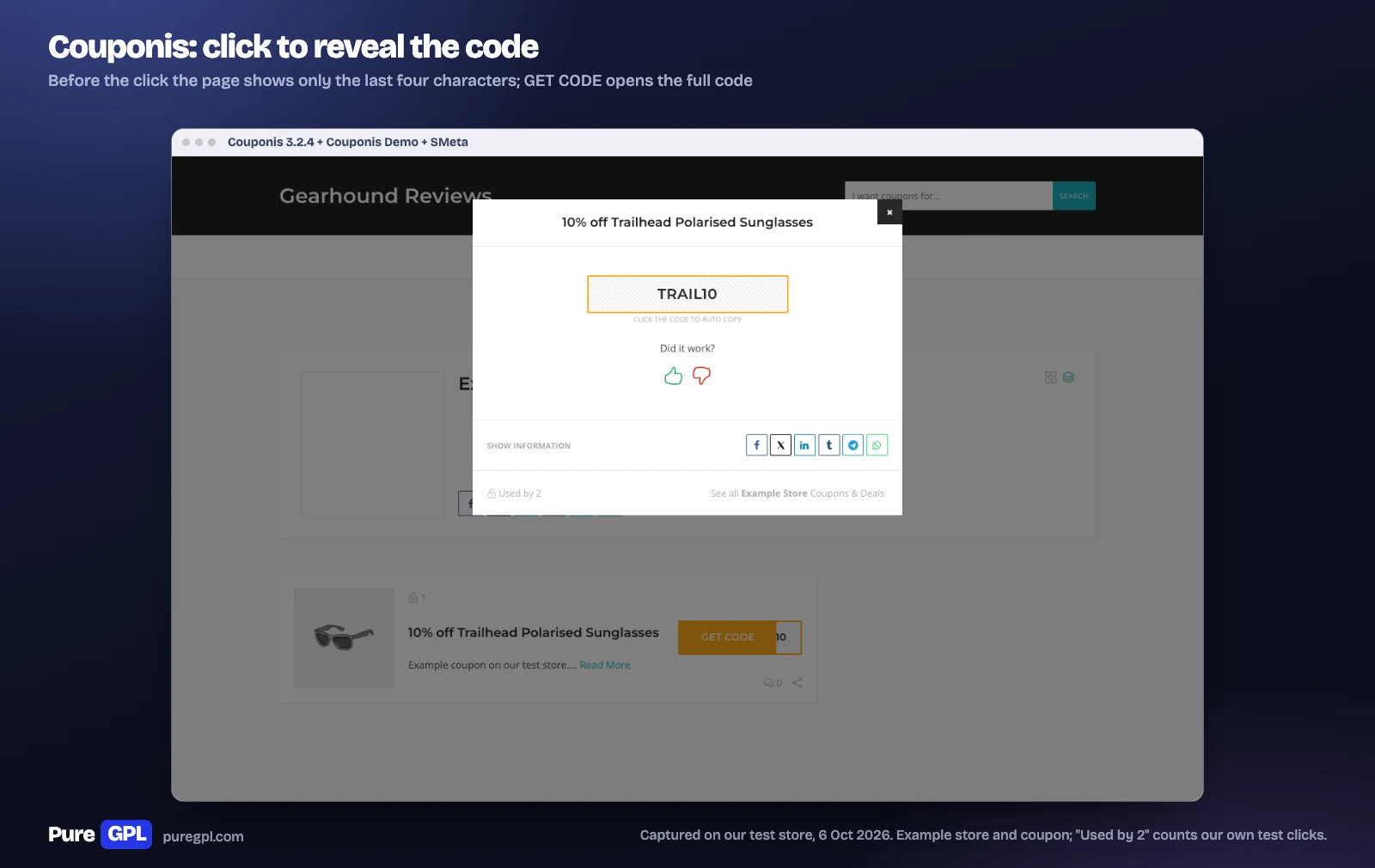
On our review post, the desktop first screen showed the header, a search box and the featured image; the post title sat below it.
Best for: a coupon site you are happy to maintain yourself. Skip it if: you want support when something breaks.
4. Tokoo
Tokoo, by MadrasThemes, is a WooCommerce theme styled as an electronics store, built, in its ThemeForest title, “for Affiliates, Dropship and Multi-vendor Websites” (1,155 sales, rated 4.98 from 43 reviews, last updated 30 September 2026). The idea is an affiliate store: the pages look like a shop, but the buy buttons send visitors to the merchant.
That part is WooCommerce’s, not Tokoo’s. WooCommerce’s “external/affiliate product” type showed our “Check price at Example Store” button in every one of the thirteen themes. What Tokoo adds is the shop look: its header, category menu and search. On our blog post, Tokoo printed the post title as a second-level heading, so the page had no first-level heading at all, and it made the most requests of any theme, 46.
Best for: a product catalogue that should feel like a shop. Skip it if: your site is mostly articles.
5. Schema
Schema, by MyThemeShop, is not an affiliate theme but is on many affiliate lists. It sells itself as the “Fastest SEO Theme Available for WordPress”, at $39 in a sale (normally $49) for unlimited sites. In our test it had the quickest largest paint (2.7 s), but it was the second heaviest theme on the review post, at 477.3 KB, mostly because of the Facebook, Twitter and Pinterest scripts it loads by default, plus 151.2 KB of icon and Google fonts.
Its page says it “includes rich snippets”. On our post it printed breadcrumb and page markup; for reviews, its plugin list recommends MyThemeShop’s WP Review plugin, which we did not install, and Rank Math for SEO. Two more things: when we activated it, it downloaded and installed MyThemeShop’s Connect plugin from mythemeshop.com on its own (its code switches back to your previous theme if that install fails), and its product page lists “WordPress Upto 6.7.9” while WordPress is now at 7.0.
Best for: existing Schema sites, with the share buttons switched off. For a new affiliate blog, GeneratePress and Kadence were lighter in our test.
The general-purpose themes
6. GeneratePress
GeneratePress loaded the lightest version of our review post: 165.1 KB and 20 requests, Lighthouse 94, and the theme folder is 2.6 MB. It adds no shortcodes or content types, so nothing breaks if you leave. One default to change: it puts the featured image above the title, so with our square image the title fell below the first desktop screen. GP Premium, the paid add-on with its site library and theme builder, is $59 a year for up to 500 sites, the lowest per-site cost here for anyone with several sites. One thing to check: the free theme on WordPress.org was last updated on 1 December 2025.
Best for: review blogs and anyone running several sites.
7. Kadence
Kadence is a block-based theme with a header builder and starter templates. It was the second lightest on our review post (206.9 KB) and, like GeneratePress, registers nothing your content depends on. Its pricing has moved: kadencewp.com’s pricing page now redirects to Liquid Web, where Essentials (theme and blocks) is $99 a year, Pro $299 and Elite $499, and “Plans are priced per site”. One site is fine; ten sites cost ten times as much.
Best for: one serious affiliate site where you want a richer block library than GeneratePress.
8. Astra
Astra is the most installed theme here, with 1,000,000+ active installations on WordPress.org. It made 20 requests on our post and scored 94. Astra Pro on its own is $69 a year for up to 3 websites, or $249 once; the bundles start at $99 the first year and renew at $149.
Best for: sites built with a page builder or Astra’s starter templates.
9. Blocksy
Blocksy matched GeneratePress on requests (20) and scored 94, with a WordPress.org rating of 100 out of 100 from 873 reviews. Its paid plan is $69 a year or $199 once for one site, and its FAQ says sites keep working if you stop renewing.
Best for: a free theme with a modern header builder.
10. Neve
Neve was light (208.5 KB, Lighthouse 93), and every Neve Pro plan covers unlimited sites. The first-year price is half the renewal, though: Personal is $69, then $139, and the page says “all renewals are at full price”.
Best for: several small sites on one licence.
11. OceanWP
OceanWP loaded the heaviest version of our review post: 489 KB and 44 requests, with the lowest Lighthouse score (77). Its default post layout also opened with a “Blog” banner, which is the page’s only first-level heading, then the featured image, with the post title below them as a second-level heading. Its Starter plan is cheap, $42 the first year at its introductory price and renewals at 20% off full price, but you would want to switch off its icon fonts and scripts first.
Best for: existing OceanWP sites. Skip it if: you are starting fresh.
12. Divi
Divi, by Elegant Themes, is a visual builder as much as a theme. We tested Divi 5.12.0: 283.1 KB and 34 requests on our post, Lighthouse 84, and 124 MB on disk, the largest theme here by far. It is $89 a year or $249 once for unlimited sites, which is good value if you will build many pages visually. We did not build pages in Divi’s builder for this test, so we did not test what is left of them after a theme change.
Best for: people who want to design every page by dragging and dropping.
13. Authority Pro
Authority Pro, by StudioPress, is a Genesis child theme for personal brands and experts. It is not sold on its own: it comes with Genesis Pro ($360 a year, unlimited sites, with all StudioPress themes) or free with WP Engine or Flywheel hosting. Out of the box it showed a blue bar across the top advertising “my fresh new course” at “25% OFF Today Only!”. That is the theme’s built-in demo text, and you will want to change it. Its layout shift of 0.16 in Lighthouse was the second highest after Schema.
Best for: a personal-brand affiliate site on WP Engine hosting.
Also considered: Clipper
Clipper, by AppThemes, is a coupon theme several lists include, at $69 with a lifetime licence for unlimited sites and 12 months of support and updates. We could not test it fairly. The copy we had was version 2.0.6, and on our PHP 8.3 store it stopped the site with a fatal error. AppThemes fixed “PHP8 issues” in 2.0.8 in July 2021, and its latest release is 2.0.10, a maintenance release from 13 March 2023. If you consider Clipper, ask AppThemes whether it is still maintained.
Affiliate features, theme by theme
| Theme | Review box with score | Ranked list or comparison table | Coupon or bonus codes | Review structured data in our test | WooCommerce external products |
|---|---|---|---|---|---|
| REHub | Yes, shortcode and block | Yes, comparison table and offer listing blocks | Yes, in its offer box, with an option to mask the code | Yes, once a score is set | Yes |
| Mercury | Yes, through ACES | Yes, ranked lists through ACES | Bonus codes, through ACES | Yes, on each item page | Yes |
| Couponis | No | No | Yes, click to reveal | No | Yes |
| Tokoo | No | A product compare template, for the YITH compare plugin | No | No | Yes |
| Schema | Through the WP Review plugin it recommends | No | No | No | Yes |
| GeneratePress, Kadence, Astra, Blocksy, Neve, OceanWP, Divi, Authority Pro | No | No | No | No | Yes |
For the general themes, “No” means the free theme as we tested it; their paid add-ons and page builders were not tested. All thirteen showed WooCommerce’s external product button and kept the rel="sponsored nofollow" on our buttons.
Lock-in: what your content depends on
| Theme | Shortcodes added | Blocks added | Post types added | What we saw after switching |
|---|---|---|---|---|
| REHub (with REHub Framework) | 131 | 48 | None | Offer and review boxes became raw shortcode text |
| Mercury (with ACES) | 42 | None | 3 (casinos, games, bonuses) | Ranked list became raw shortcode text |
| Divi | 41 | 2 | 1 (projects) | Not tested |
| Authority Pro (with Genesis) | 20 | None | None | Genesis’s shortcodes are used in its templates, not in posts |
| Couponis (with its plugins) | 5 | None | Coupons, plus Elementor’s own | Coupon details are partly kept in its own database table |
| Tokoo (with Redux) | 3 | None | None | Redux’s general shortcodes, not used in posts |
| Blocksy | 1 | None | None | A breadcrumbs shortcode |
| GeneratePress, Kadence, Astra, Neve, OceanWP, Schema | None | None | None | Nothing to lose |
Counts are what each theme and its required plugins registered on our store, compared with Twenty Twenty-Five. Couponis’s count includes general shortcodes from the Redux framework and Elementor it needs, and Tokoo’s from Redux.
Licence, support and refunds
| Theme | Sites per licence | How you pay | Refund window on the pricing page | Current version |
|---|---|---|---|---|
| REHub | 1 | Once; 6 months support, extendable to 12 | Not stated on the item page | 19.9.9.8 |
| Mercury | 1 | Once; 6 months support, extendable to 12 | Not stated on the item page | 3.11 |
| Tokoo | 1 | Once; 6 months support, extendable to 12 | Not stated on the item page | 1.2.2 |
| Couponis | 1 | Once; no support from the developer | Not stated on the item page | Last updated 9 June 2026 |
| GeneratePress (GP Premium) | Up to 500 | Yearly | 30 days | 3.6.1 (free theme) |
| Kadence (Essentials) | Priced per site | Yearly | Not stated | 1.5.2 (free theme) |
| Astra (Astra Pro on its own) | Up to 3 | Yearly or lifetime | 14 days | 4.14.0 (free theme) |
| Blocksy (Personal) | 1 | Yearly or lifetime | 14 days | 2.1.58 (free theme) |
| Neve (Personal) | Unlimited | Yearly | 30 days | 4.2.15 (free theme) |
| OceanWP (Starter) | 1 | Yearly or lifetime | 14 days | 4.2.6 (free theme) |
| Divi | Unlimited | Yearly or lifetime | 30 days | 5.12.0 |
| Authority Pro (Genesis Pro) | Unlimited | Yearly, or free with WP Engine hosting | Not stated | 1.5.3 |
| Schema | Unlimited | Subscription: 1 year of updates and support; renewal price not stated | 30 days | 3.9.23 |
What other lists get wrong
- Astra’s price. One list gives Astra Pro as “~$47/yr” and another as “from ~$49/yr”. Astra’s pricing page sells Astra Pro on its own at $69 a year, and the cheapest bundle at $99 the first year, then $149. A third list gives “$59 to $249 a year”; the bundles now run from $99 to $279 in the first year and renew at up to $429.
- Kadence’s price. One list gives “Pro: $119/yr”. Kadence now sells through Liquid Web: Essentials is $99 a year, Pro $299 and Elite $499, priced per site.
- GeneratePress “lifetime available”. GeneratePress’s pricing page lists only yearly prices: GP Premium at $59 a year and GeneratePress One at $149.
- Neve’s prices. One list gives $69, $149 and $259 as the plan prices. Those are first-year sale prices; Neve’s page shows $139, $299 and $519 and says renewals are at full price.
- OceanWP’s price. One list gives “~$44/yr”. OceanWP’s Starter plan is $42 the first year at its introductory price, normally $52.
- “One-time” ThemeForest prices. REHub at $59 and Clipper at $69 are listed as one-time without saying that REHub’s support lasts six months and Clipper’s updates twelve.
- “Less than 50KB”. Two lists repeat Astra’s claim that it uses less than 50 KB. On our review post, with WooCommerce active, Astra loaded 28.7 KB of stylesheets and 63.8 KB of scripts; much of that is WooCommerce’s and WordPress’s, so the claim is about Astra’s own files, not what a reader downloads.
- Couponis’s support. No list we read says its ThemeForest page now reads “spoonthemes does not support this item”.
- Schema and speed. One list scores Schema “Speed: 10/10” with “Ultra-fast load times” and “Rich snippet support built-in”. On our post Schema had the quickest largest paint, but it was the second heaviest of the thirteen themes we tested, and without the WP Review plugin it recommends it printed no review structured data.
How we tested, in full
We set up a test store on WordPress 7.0.2 with WooCommerce 11.1.2 and PHP 8.3, imported WooCommerce’s sample products, turned two of them into external (affiliate) products, and wrote one example review post using only WordPress’s own blocks: a disclosure, a comparison table, three product sections with images, pros and cons, “Check price” buttons with rel="sponsored nofollow", and two FAQ blocks. Five shorter example posts filled the home page. The products, prices and scores on the store are example data.
We then activated each theme in turn with only the plugins it marks as required: REHub Framework for REHub; ACES, Mercury Addons and One Click Demo Import for Mercury; Redux, Elementor, SMeta and Couponis Demo for Couponis; Redux for Tokoo; Genesis as Authority Pro’s parent theme. No demo was imported and no setting was changed, so each theme is shown as it arrives. For each theme we loaded the home page, the review post, the shop and one product in Chrome with the cache off, a fresh browser session per page, and recorded the files, requests and bytes transferred. We ran Lighthouse’s mobile test three times on the review post and report the middle score. We captured the post on desktop and at phone width, recorded where each theme placed the post title and which heading it used, and counted the shortcodes, blocks and content types each theme registered against Twenty Twenty-Five.
For REHub, Mercury and Couponis we built one example of each theme’s own affiliate feature (an offer and review box, a ranked list, a coupon), captured it, and for REHub and Mercury switched back to Twenty Twenty-Five to see what remained. We read each theme’s code for its affiliate features, structured data and required plugins.
The six free themes came from WordPress.org and matched it file for file. The paid themes came from our own catalogue, and we had no developer download to compare them with. Our REHub copy writes a purchase code and replaces REHub’s licence check, so features that depend on a licence may behave differently from the developer’s release. Our Mercury copy is 3.9.12, older than the developer’s 3.11. Clipper was not tested, for the reason given above. We did not test the paid add-ons of the free themes (GP Premium, Kadence Pro and the others), and we did not import any theme’s demo.
Divi was measured last, with the newer 5.12.0 we sell, after the example feature posts had been added, so its menu and recent-posts list also include the example feature pages we added for REHub and Mercury. Prices, ratings, sales and versions were read from each developer’s page, ThemeForest and WordPress.org on 6 October 2026. ThemeForest blocks automated reading, so its figures were read through a web reader on the same day.
On PureGPL
We sell GPL copies of several of these: REHub 19.9.9.8, Divi 5.12.0, Astra Pro, GP Premium and Blocksy Companion Premium at $4.99, and Couponis 3.2.4, Tokoo 1.2.2, Mercury 3.9.12, Schema 3.9.23, Authority Pro 1.5.3, Kadence Theme Pro and Neve Pro at $3.49.
What a GPL copy does and does not include
WordPress themes are licensed under the GPL, which allows redistribution; check each developer’s own licence for the terms, since some ThemeForest items split the licence between the code and the design. A GPL copy comes without a licence from the developer, so it comes without the developer’s support, and anything that runs through the developer’s account, such as REHub’s demo and plugin downloads or MyThemeShop’s Connect updates, is not part of it. Updates come from us. If you want the developer’s support, buy from the developer. We explain the licence in Is GPL legal?
Sources
Prices, plans, ratings and installation counts were read from these pages on 6 October 2026. The screens, page weights, Lighthouse scores and code findings are from our own test store.
- REHub on ThemeForest
- Mercury on ThemeForest
- Couponis on ThemeForest
- Tokoo on ThemeForest
- Envato item support policy and licence FAQ
- Schema by MyThemeShop
- Clipper by AppThemes and its 2.0.10 and 2.0.8 release notes
- GeneratePress pricing
- Kadence pricing (Liquid Web)
- Astra pricing
- Blocksy pricing
- Neve pricing
- OceanWP pricing
- Divi pricing
- Authority Pro and Genesis Pro
- WordPress.org theme directory listings for Kadence, Astra, GeneratePress, Neve, OceanWP and Blocksy
- Google’s Cumulative Layout Shift thresholds
Frequently asked questions
What is the best WordPress theme for affiliate marketing?
For most affiliate blogs, GeneratePress: it loaded the lightest version of our review post of the thirteen themes we tested, and GP Premium costs $59 a year for up to 500 sites. For price comparison and deals, REHub. For ranked “top 10” lists, Mercury.
Can I use a free theme for affiliate marketing?
Yes. Affiliate links work in any theme, and five free themes (GeneratePress, Kadence, Neve, Blocksy and Astra) loaded our review post with less weight than WordPress’s own default theme. Review boxes and comparison tables can come from blocks or a plugin.
Is Astra good for affiliate marketing?
Yes for most blogs: it loaded our review post with 20 requests and scored 94 in Lighthouse. It has no affiliate features of its own; Astra Pro on its own is $69 a year for up to 3 websites.
Is GeneratePress good for affiliate marketing?
It loaded the lightest version of our review post, at 165.1 KB, and it adds nothing your content depends on. Like Astra, it has no review boxes or comparison tables of its own.
Is REHub worth it?
For price comparison and deals sites, yes: $59 once gets you comparison, offer and review blocks and Content Egg templates. For a simple blog, no: it registers 131 shortcodes, and the ones in your posts turn into raw text if you ever switch theme.
Do I need a special theme for Amazon affiliate links?
No. To show Amazon products with live prices you need a plugin such as AAWP or Content Egg and an approved Amazon Associates account; the theme only displays what the plugin outputs. REHub has templates for Content Egg built in.
Does the theme affect SEO?
Through speed, headings and structured data, yes. In our test, page weight on the same post ranged from 165.1 KB to 489 KB, Tokoo printed no first-level heading on posts, and only REHub and Mercury printed review structured data on their own.
Which affiliate themes have a lifetime licence?
ThemeForest themes (REHub, Mercury, Couponis, Tokoo) are paid once, with updates kept and six months of support. Divi ($249), Astra Pro ($249), Blocksy ($199) and OceanWP ($168 for one site) also sell lifetime licences.
Related: REHub review, Mercury review, the best WordPress affiliate plugins, Content Egg review and how to start affiliate marketing with WordPress.