How to Start Affiliate Marketing With WordPress: A Step-by-Step Guide
How to start affiliate marketing with WordPress: choosing a topic, joining programs, managing links, writing content and disclosing properly.

Affiliate marketing is simple to describe: you recommend a product, your reader buys through your link, and the seller pays you a share. WordPress is where most affiliate sites are built, because you own the site and can shape it around the content. This guide goes through it in order, from choosing a topic to the first commission, with the tools for each step.
We will be straight about one thing first. It is slow. A new site usually waits months for search traffic, and many sites never earn much. Nothing below is a way round that. It is the work, in order.
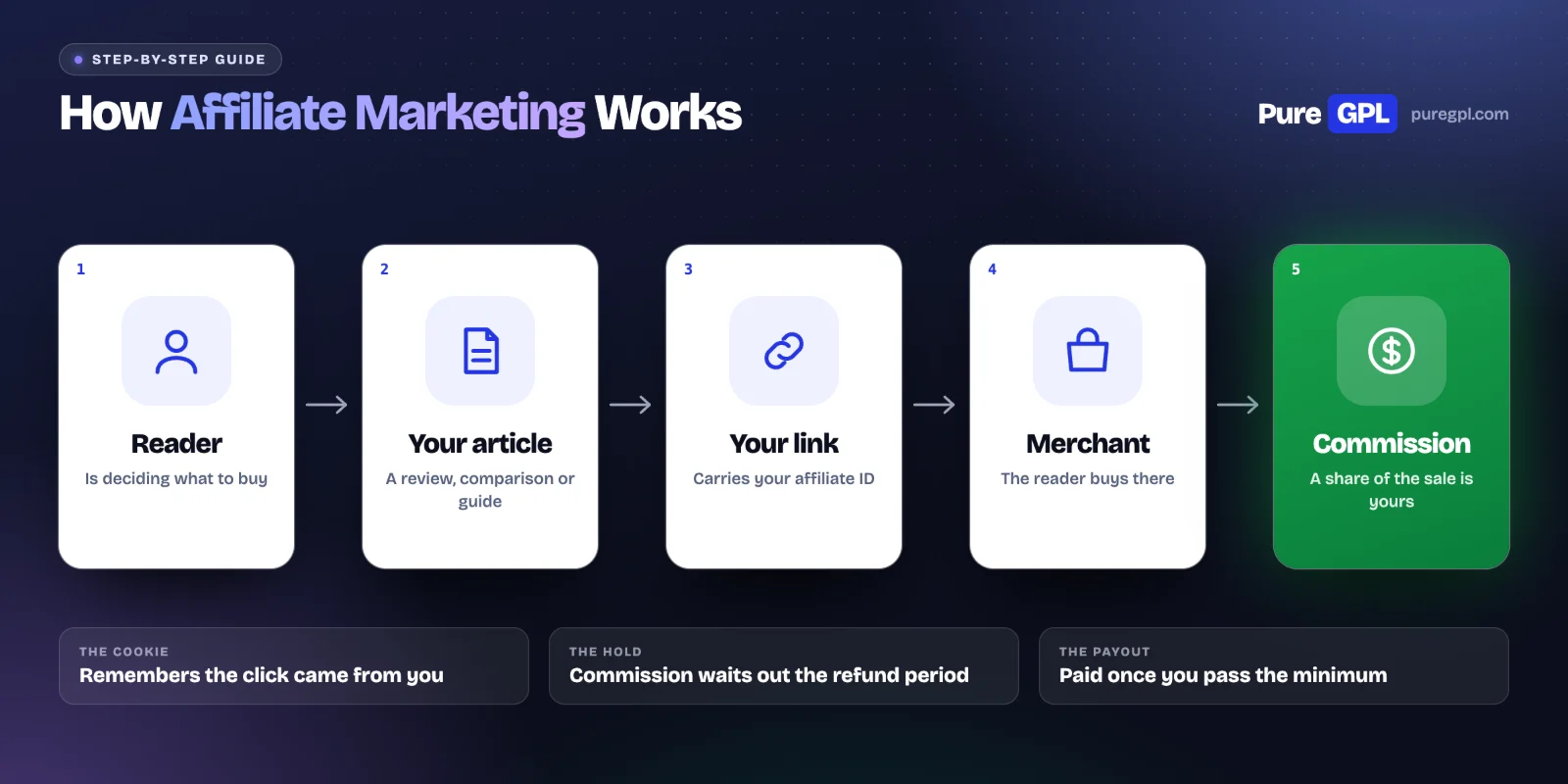
How the money moves
- You join a merchant’s affiliate program and get a personal link.
- A reader clicks it. The merchant’s site stores a cookie that records the click came from you.
- If the reader buys within the cookie period, the sale is credited to you.
- The commission waits out the refund period, then becomes payable.
- You are paid once you pass the program’s minimum payout.
Three numbers decide what a program is worth: the commission rate, the cookie length, and the minimum payout. Read all three before you write a word about a product.
Step 1: Choose a topic you can keep writing about
Pick something where people buy things and ask questions before they buy. A good test: can you list thirty articles you could write without research, and are there products with affiliate programs in it? If both answers are yes, it is workable.
Narrow beats broad. “WordPress plugins for restaurant websites” is easier to win than “WordPress”.
Step 2: Set up the site
- Domain and hosting. Use self-hosted WordPress (WordPress.org software on your own hosting), so you control plugins and links.
- Theme. A fast general theme is enough for an article-led site. If the whole site is comparisons, coupons or ranked lists, a dedicated theme saves work. See best affiliate marketing WordPress themes.
- Basics. An SEO plugin, a caching plugin, backups.
Step 3: Join programs
There are two kinds.
- Networks such as Amazon Associates, CJ Affiliate, Awin and Impact hold thousands of merchants under one account.
- Direct programs are run by the seller. They often pay a higher rate than a network pays for the same sort of product.
For a WordPress-related site, we have collected rates, cookie lengths and payout rules for ten programs in best WordPress affiliate programs. Our own is among them: the PureGPL affiliate program pays 40% on every new order, with payouts from $20.
Most programs want to see a live site with some content before they approve you, so publish a handful of articles first.
Step 4: Manage your links
Raw affiliate links are long and change over time. A link plugin gives each one a short address on your own domain, counts clicks, and lets you update the destination in one place.
- Pretty Links Pro is the usual choice. See our review.
- One exception: Amazon does not allow its links to be cloaked in a way that hides that they go to Amazon. Use Amazon’s own links for Amazon products.
Step 5: Show products well
A plain text link works. A clear product box with a picture, the current price and a button usually gets more clicks.
- AAWP for Amazon: product boxes, bestseller lists and comparison tables that update automatically.
- Content Egg for many networks at once, with price comparison.
Step 6: Write the content that earns
Four formats do most of the work:
- Reviews of one product, for people close to buying.
- Comparisons, “A vs B”, for people choosing between two.
- Roundups, “best X for Y”, for people who have not shortlisted yet.
- Tutorials, where the product is the tool that solves the problem.
What separates content that ranks from content that does not is first-hand detail. Use the product. Take your own screenshots. Say what annoyed you. Give the real price, including the renewal price. Say who should not buy it. Readers and search engines can both tell the difference between that and a rewritten sales page.
Step 7: Disclose, and mark your links
This part is not optional.
- Tell readers. In the United States the FTC requires a clear disclosure, placed where readers will see it, when you earn from a recommendation. Many other countries have similar rules. A short line near the top of the article does it: “We may earn a commission if you buy through links on this page.”
- Amazon requires its associates to display a specific statement: “As an Amazon Associate I earn from qualifying purchases.”
- Tell search engines. Google asks that affiliate links carry
rel="sponsored". Link plugins can add it automatically. - Read each program’s terms. Many forbid bidding on the brand’s name in ads, and some forbid email promotion.
Step 8: Measure, then repeat what works
Look at two things each month: which pages get clicks on affiliate links, and which of those clicks turn into sales (your program dashboards show that). Update the pages that earn, and write more like them. Leave the rest.
The other side: running your own program
If you sell something yourself, you can have affiliates sell it for you. That needs a different kind of plugin, such as AffiliateWP or Solid Affiliate. We cover those in best WordPress affiliate plugins.
Common mistakes
- Joining a program before reading its cookie length and minimum payout.
- Writing about products you have never used.
- Hiding the disclosure in the footer.
- Putting every link through Amazon when a direct program pays several times more.
- Giving up at month three.
Frequently asked questions
Can I do affiliate marketing on WordPress.com?
Affiliate links are allowed on WordPress.com within its rules, but plugins need one of its higher plans. Self-hosted WordPress gives you full control.
How much does it cost to start?
A domain and basic hosting. Everything else can begin with free plugins and be upgraded when the site earns.
How long until I earn?
There is no honest fixed answer. Search traffic to a new site usually takes months to build, and earnings follow traffic.
Do I need a lot of traffic?
Less than you might think if readers arrive ready to buy. A hundred visitors to a detailed comparison can be worth more than thousands to a general article.
Do I have to disclose affiliate links?
Yes. It is a legal requirement in the United States and many other countries, and a condition of most programs.