Is GPL Legal? WordPress Licensing, Explained Without the Hand-Waving
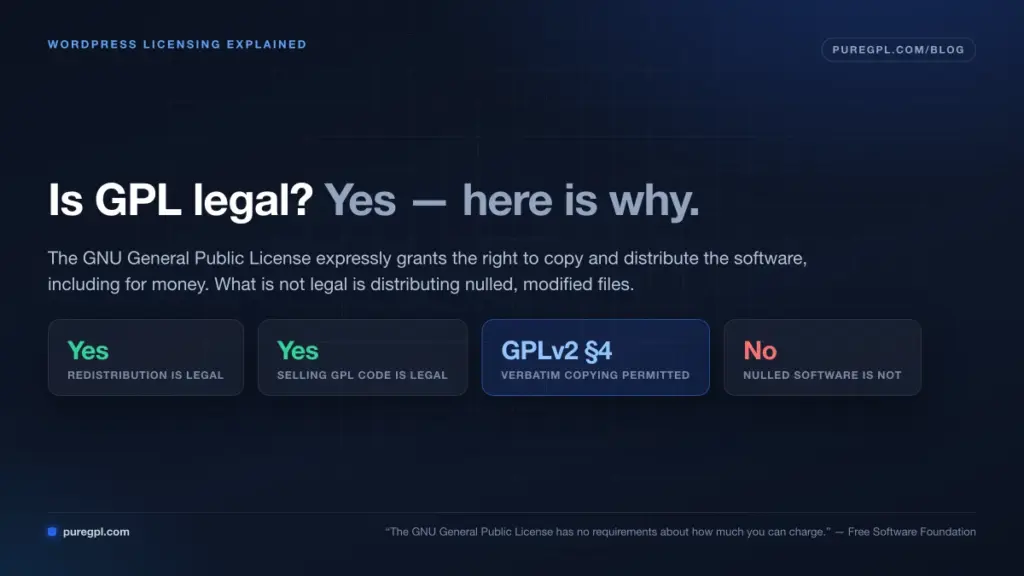
Is GPL legal? Yes - the licence expressly permits redistribution, including for money. Here is what the GPL allows, and where nulling crosses the line.

Last updated: 17 September 2026
Quick Answer
Yes. Redistributing GPL-licensed WordPress themes and plugins is legal, including for money. The GNU General Public License expressly grants the right to copy and distribute the software, and the Free Software Foundation states that “The GNU General Public License has no requirements about how much you can charge.” What is not legal is distributing nulled software — files modified to strip out licence verification.
Where the Permission Comes From
The chain of reasoning is short and it holds up.
1. WordPress is GPLv2. The core software has been licensed under the GNU General Public License version 2 (or later) since its release.
2. Themes and plugins inherit it. Because they call WordPress functions, hooks and classes, the prevailing interpretation — endorsed by the WordPress Foundation and backed by a 2009 Software Freedom Law Center opinion — is that the PHP in themes and plugins constitutes a derivative work and must therefore be GPL. (CSS, JavaScript and images are treated as separable, which is why some developers use a “split licence”.)
3. The GPL grants redistribution rights. GPLv2 §1 permits verbatim copying and distribution of the source. §2 and §3 extend that to modified versions and to object code, on conditions. Nothing in the licence lets an author restrict how many sites you install on, or forbid you from passing copies on.
4. Charging money is expressly allowed. This is the part people find counterintuitive. The FSF is direct about it: “We encourage people who redistribute free software to charge as much as they wish or can.” Free means freedom, not price.
So when a GPL site buys one developer licence and redistributes the files to thousands of members, it is exercising a right the licence grants.
What You Were Actually Paying the Developer For
If the code can be freely redistributed, why does the developer charge $199 a year?
Not for the code. For everything attached to it:
| What you pay for | Can it be redistributed? |
|---|---|
| The PHP source | No restriction — GPL |
| Official updates via their servers | No — that’s their infrastructure |
| A licence key | No — that’s an access credential |
| Support tickets | No — that’s a service |
| Cloud features (templates, AI credits) | No — that’s a SaaS they operate |
| Trademarks and branding | No — separate law entirely |
A GPL site can lawfully give you the first row. It cannot give you the rest. That is the whole trade-off, and any vendor pretending otherwise is misleading you.
Where the Line Actually Is
Four distinct activities, only one of which is clearly unlawful:
✅ Redistributing unmodified GPL files. Permitted by the licence.
✅ Charging for that redistribution. Permitted, explicitly.
✅ Modifying GPL code and redistributing it as GPL. Permitted, provided you keep it GPL, retain the notices and state your changes.
❌ Nulling. Modifying software specifically to defeat licence verification, then distributing it. This is not ordinary GPL redistribution — it is circumvention of a technical protection measure, and in most jurisdictions it is infringement. It is also the vector for essentially all WordPress malware in this category.
There is also a genuine grey area worth naming honestly: trademarks. The GPL covers copyright, not trademarks. A vendor may lawfully redistribute the code of a branded plugin while still having no right to use that brand’s logo in its own marketing. Many GPL sites are casual about this. It’s a risk to the vendor, not usually to you.
Does a Developer’s “One Site Licence” Override the GPL?
No — not for the code. A developer cannot use terms of service to remove rights the GPL grants to code they released under the GPL. That is precisely what GPLv2 §6 prevents: “You may not impose any further restrictions on the recipients’ exercise of the rights granted herein.”
What the developer can do is terminate your access to their servers, their updates, their support and their licence key. Those were never GPL-covered. So the practical position is: you keep the code, you lose the service.
Is GPL Legal in India, the UK, the EU, the US?
The GPL is a copyright licence, and copyright is governed by national law implementing the Berne Convention — to which all of these are parties. A licence granting redistribution rights is enforceable in all of them. There is no jurisdiction among the major markets where redistributing GPL software is unlawful per se.
Nulling is treated more harshly in some places than others — the US DMCA §1201 and the EU InfoSoc Directive Article 6 both specifically target circumvention of technical protection measures — but it is nowhere lawful.
Note that GPL sites operating from India frequently price in INR and accept UPI; PureGPL accepts UPI, netbanking and wallets via Razorpay alongside cards and PayPal via Stripe, and offers an INR currency view. That’s a payments question, not a legal one.
Is It Legal to Resell GPL Products I Downloaded?
Under the licence, yes — the GPL permits onward redistribution, and recipients get the same rights you did.
Two practical caveats:
- Your vendor’s terms may forbid it even though the licence permits it. That’s a contract matter between you and them, separate from copyright. Most standard memberships prohibit reselling; dedicated reseller plans exist precisely for this — PureGPL offers them at $89 for six months or $139 per year, WorldPressIT’s Gladiator tier at $199.95.
- You cannot resell the developer’s trademarks, support or licence keys. Only the code.
FAQ
Is GPL legal? Yes. The GNU General Public License is a valid, widely-enforced copyright licence that expressly permits copying, distribution and modification, including commercially.
Is it legal to sell GPL themes and plugins? Yes. The FSF states plainly that the GPL imposes no limit on what you may charge. The obligation is to preserve the licence and the freedoms, not to give the software away.
Are GPL sites legal? Legitimate ones, yes — they redistribute unmodified GPL code, which the licence permits. Sites distributing nulled files are not, regardless of what they call themselves. The distinction is covered in full in our GPL vs nulled guide.
Can a developer sue me for using a GPL plugin from a GPL site? For using unmodified GPL code, they would be suing over rights their own licence granted. What they can do is cut off your updates, support and key — and terminate any account you hold with them.
Does using a GPL site void my right to support? You never had one. Support is a service sold alongside the code, and you didn’t buy it.
Which GPL sites operate transparently? Look for a published terms of service, copyright policy, contact details and a stated file-integrity policy. We assessed ten vendors on exactly this in our best GPL site comparison.
Bottom Line
Is GPL legal? Yes, and it isn’t a close call — the licence was written specifically to permit what GPL sites do. The legitimate concern in this market was never legality. It’s whether the vendor ships the original files or a modified copy. Pick one that ships originals.
→ See the 10 best GPL sites, scored on file integrity and transparency