WP Ghost Review 2026: Does This Security Plugin Deliver?

Automated bots scan thousands of WordPress sites every hour, looking for exposed file paths, outdated plugins, and default folder structures they can fingerprint and exploit. This WP Ghost review looks at a plugin built specifically to close that exposure by hiding core paths, plugins, and theme details from scanners before an attacker even gets that far. The pitch is simple: if bots can’t identify what you’re running, they can’t target it as easily.
The real question is whether obfuscation-based security like this actually reduces risk in practice, and whether it’s enough on its own or needs to sit alongside a traditional firewall plugin.
Quick Verdict
WP Ghost suits site owners who want to cut down automated scanning and brute-force attempts without wrestling with a complex security dashboard. It’s a poor fit for anyone expecting a full malware scanner or firewall replacement, since its focus stays narrow by design.
Pros
- Hides WordPress core file paths, installed plugins, and active theme details from bots and scanners
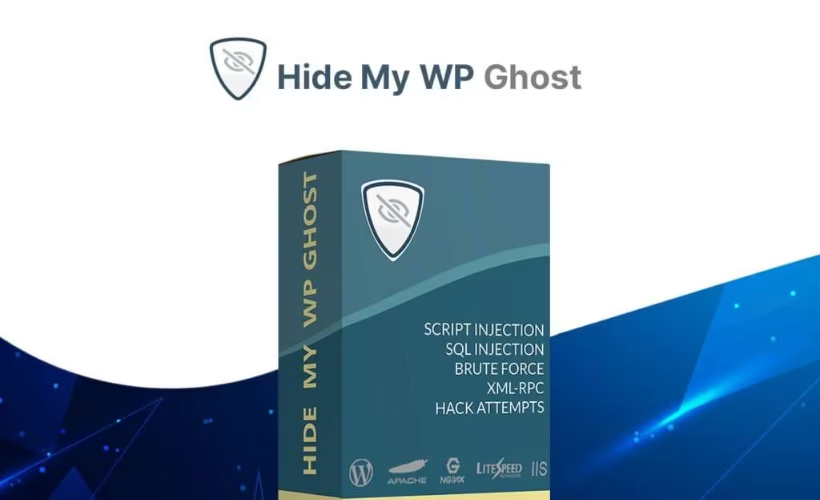
- Blocks brute force login attempts, SQL injection, XML-RPC exploitation, and XSS attacks
- Free version available for testing before committing to Pro
- Fast, straightforward installation directly from a zip upload with no extraction required
- Dedicated support offered alongside the plugin
Cons
- Focuses narrowly on obfuscation and fingerprint-hiding rather than a full firewall or malware scanning suite
- Hiding paths and plugin details adds a layer of defense but doesn’t replace active malware detection and removal
- No listed companion plugins or add-ons to extend functionality beyond its core focus
Core Features

WordPress Path and File Hiding
WP Ghost’s core function is masking the file paths that reveal a site is running WordPress — the default /wp-content/, /wp-includes/, and core directory structures that automated scanners use to fingerprint a target. Instead of leaving these paths exposed for any bot to read, the plugin obscures them so a scanner sees generic or altered paths rather than the standard WordPress layout.
For a site owner, this matters because most attacks on WordPress start with automated reconnaissance, not a human typing commands. If a scanning bot can’t confirm the site is running WordPress in the first place, it has less reason to move on to targeted exploit attempts against known WordPress vulnerabilities.
Plugin and Theme Detection Hiding
Beyond core paths, WP Ghost also hides which plugins are active on a site. Plugin slugs, version numbers, and readme files are commonly exposed by default WordPress installs, and they’re exactly what an attacker needs to check a site against a database of known plugin vulnerabilities.
The same concealment extends to active theme information. Combined, these two features mean a scanner probing the site can’t easily build a list of installed software to cross-reference against exploit databases — closing off one of the more common paths bots use to find a vulnerable target before a human ever gets involved.
Brute Force Attack Prevention
WP Ghost includes brute force attack prevention aimed at the repeated login attempts that automated scripts use to guess WordPress credentials. This targets one of the oldest and still most common attack methods against WordPress sites: scripts hammering wp-login.php with credential lists until something works.
For site administrators, this reduces the volume of automated login attempts hitting the site, which also has a secondary benefit of cutting server load generated by failed login requests.
SQL Injection Protection
The plugin blocks SQL injection attempts, a class of attack where malicious code is inserted into input fields or URL parameters in an attempt to manipulate the site’s database queries. SQL injection remains one of the more damaging attack types because a successful one can expose or corrupt an entire database.
Blocking this at the plugin level gives a site an additional layer of defense against attempts to read or alter database content through vulnerable forms, search fields, or URL-based query manipulation.
XML-RPC Attack Blocking
WP Ghost restricts XML-RPC based attacks. XML-RPC is a WordPress feature that, left open, is frequently abused for pingback-based denial-of-service attempts and as an alternate route for brute-forcing login credentials outside the standard login page.
Restricting this attack surface closes a route that many brute force and amplification attacks rely on specifically because it bypasses the usual login-page defenses.
XSS Protection
Cross-site scripting protection rounds out the plugin’s attack-blocking features, targeting attempts to inject malicious scripts into pages viewed by other site visitors or administrators. XSS attacks are typically used to steal session cookies, redirect visitors, or run unauthorized code in a victim’s browser.
Paired with the plugin’s brute force, SQL injection, and XML-RPC protections, this gives WP Ghost coverage across several of the attack categories that automated scanners commonly probe for on WordPress sites, on top of the fingerprint-hiding it’s built around.
Installation and Setup
- Get the plugin file. Free tier users can download the free version for installation, while Pro buyers receive the plugin package after purchase through the official site.
- Log in to the WordPress dashboard and navigate to Plugins → Add New Plugin → Upload Plugin.
- Select the plugin’s zip file and upload it directly — there is no need to extract the archive first.
- Click Install Now, then Activate the plugin once the upload finishes.
- Open the plugin’s settings screen and configure the core protections: path hiding for WordPress core, plugin, and theme files, plus the brute force, SQL injection, XML-RPC, and XSS protections.
- Review the free-versus-premium feature comparison if running the free version, to confirm which protections are active on the current tier.
In hands-on testing, this process was quick. Installing and configuring the plugin on WordPress 6.5 running PHP 8.4 took about two minutes, with the file installing directly through Plugins → Add New Plugin → Upload Plugin without any need to unzip it beforehand.
Compatibility and Requirements
WP Ghost does not require any companion plugins to run its core hiding and attack-blocking features.
In practice, the plugin installed and activated without issue on WordPress 6.5 running PHP 8.4. That combination reflects a currently supported PHP version, which is worth checking on your own host: sites still running end-of-life PHP branches should generally upgrade regardless of which security plugin they use, since unsupported PHP versions no longer receive security patches of their own.
Support is described as dedicated, which is relevant if a compatibility issue arises on an unusual hosting setup.
WP Ghost Pricing
Current pricing details are not available in this review. Check the official developer website for up-to-date pricing information.
A free version of WP Ghost is available for installation, with the developer offering a separate feature comparison between the free and premium (Pro) editions. This lets site owners try the core hiding and protection mechanisms before deciding whether the Pro tier’s additional features justify an upgrade.
For exact costs, license terms, and site-count allowances tied to the Pro version, visit the official hidemywpghost.com site directly.
👉 Get WP Ghost at the best available price
Alternatives to WP Ghost
WP Ghost’s approach to security is narrow but distinctive: it focuses on hiding WordPress fingerprinting details rather than acting as a full firewall or malware scanner. Site owners who want broader protection, or a different balance of features, have several established options to weigh.
| Product | Key Difference | Best For | Price Tier |
|---|---|---|---|
| WP Ghost | Hides WordPress paths, plugins, and theme details from bots while blocking brute force, SQL injection, XML-RPC, and XSS attacks | Site owners wanting to reduce fingerprinting exposure alongside basic attack blocking | Freemium |
| Wordfence Security | Combines a web application firewall with malware scanning and login security in one plugin | Users wanting an all-in-one firewall and scanner rather than an obfuscation-focused tool | Freemium |
| Sucuri Security | Centers on malware scanning and site cleanup, with a cloud-based firewall available as an add-on | Site owners prioritizing malware detection and remediation over hiding fingerprints | Freemium |
| iThemes Security (Solid Security) | Focuses on hardening WordPress settings, two-factor authentication, and file change detection | Administrators wanting configurable hardening rules and account-level protections | Freemium |
| All In One WP Security & Firewall | Free, open-source plugin covering firewall rules, brute force protection, and user account security | Budget-conscious users wanting broad coverage without a paid tier | Free |
Competitor data is sourced from publicly available information as of 2026 and may have changed.
Which option makes sense depends on what a site actually needs. A site already running a firewall and scanner might use WP Ghost as a lightweight addition for obfuscation, while a site with no security plugin at all may be better served starting with a broader suite like Wordfence or Sucuri.
Frequently Asked Questions
What does WP Ghost actually hide on a WordPress site?
WP Ghost hides WordPress core file paths, installed plugin names, and active theme information from bots and automated scanners. The goal is to make it harder for attackers to fingerprint a site and identify which vulnerabilities to target.
Is there a free version of WP Ghost?
Yes, a free version of the plugin is available for installation. The vendor also publishes a separate feature comparison showing what’s included in the free version versus the Pro version.
Does WP Ghost protect against brute force login attacks?
Yes, brute force attack prevention is one of the plugin’s core features. It’s included alongside its path and file-hiding functions as part of its broader security approach.
Does WP Ghost block XML-RPC attacks?
Yes, XML-RPC attack protection is listed among WP Ghost’s core features. This helps restrict a common attack vector used to exploit XML-RPC endpoints on WordPress sites.
How long does it take to install and set up WP Ghost?
Installation and basic setup took about two minutes when tested on WordPress 6.5 with PHP 8.4. The plugin file could be installed directly through Plugins → Add New Plugin → Upload Plugin without needing to extract the zip archive first.
Does WP Ghost protect against SQL injection and XSS attacks?
Yes, both SQL injection protection and XSS (cross-site scripting) protection are included as core features. These sit alongside the plugin’s path-hiding and brute force protection as part of its overall security coverage.
Download & Pricing Options
🆓 Free Version
👉 Download the Free Version of WP Ghost
💎 Get WP Ghost (Best Available Price)
👉 Check Current Pricing for WP Ghost
Pricing and availability may change — use the link above for current rates.
WP Ghost is available from most GPL vendors, but they are not equivalent. Our best GPL sites review tested all ten on price, catalogue and whether updates reach wp-admin at all.